
AI Rivalry Between Anthropic and OpenAI Takes Center Stage at Super Bowl
From Super Bowl commercials to super-PAC war chests, Anthropic and OpenAI are fighting to define the public, political, and moral future of artificial intelligence.

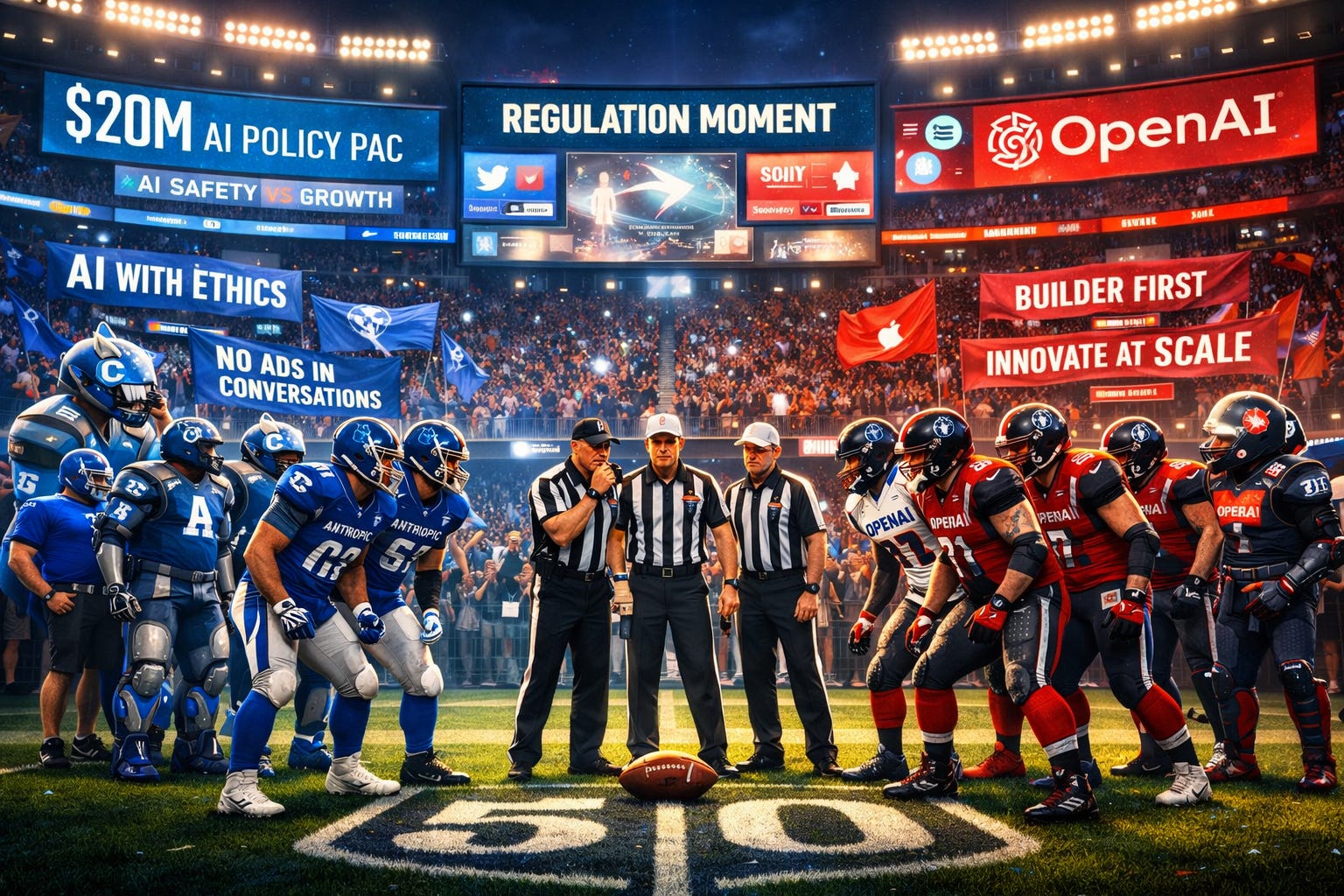
When Anthropic and OpenAI took their rivalry to Super Bowl LX last week, it marked a turning point in the saga of artificial intelligence in American life — not just as a technology, but as a cultural, political, and regulatory flashpoint. For years, tech companies have quietly entered the political arena, but Sunday night on national television signaled something more: the battle for public perception had become fully politicized.
Anthropic, best known for its Claude family of large language models and its stated mission to “study their safety properties at the technological frontier,” aired a set of Super Bowl commercials that were hard to miss. In one widely discussed spot, an AI assistant abruptly shifts mid-conversation into selling products—a playful parody aimed directly at OpenAI’s controversial decision to introduce advertising within ChatGPT. As Business Insider reported, the commercial’s message was clear: “There is a time and place for ads. Your conversations with AI should not be one of them.”
Take a look.
OpenAI’s leadership pushed back. Greg Brockman, OpenAI’s president, called Anthropic’s ads a reflection of a “fundamental difference in our respective outlooks on AI,” framing the dispute less as marketing and more as a clash between philosophical visions of the technology.
OpenAI, for its part, chose a different tone in its own Super Bowl advertisement. Rather than mocking a rival, its commercial centered on Codex — its AI coding tool — and the idea that “anyone can build things.” That messaging was earnest, focused on builders, creativity, and economic agency.
What unfolded on a stage watched by more than 100 million Americans was not mere branding. It was a strategic framing of the social contract of AI: one side warned against intrusive monetization in sensitive conversational spaces; the other celebrated broad utility and innovation. At this point, it is fair to say Anthropic is ahead on points, if not market and mind share.
That corporate tussle bled into politics almost immediately. Days after the Super Bowl, Anthropic announced a $20 million donation to Public First Action, a political group backing state-level AI regulation ahead of the 2026 midterms. According to Reuters, the group is pitched as a counterweight to Leading the Future, a rival super-PAC backed by OpenAI executives and venture-capital heavyweights that has raised around $125 million to advocate for looser regulation. Public First Action is already backing candidates such as Republican Marsha Blackburn, illustrating that the contest over AI policy is crossing traditional partisan lines.
In a few weeks, a technology dispute that once existed only in academic papers and narrow policy circles had expanded to billboards, television screens, and political capital. It has placed Silicon Valley players at the forefront of a culture war over what sort of future AI will shape, and on whose terms.
Internal tensions within AI labs reflect broader unease about the pace and direction of technological change, and Anthropic is not above reproach. In early February, Mrinank Sharma — formerly Anthropic’s head of its safeguards research team — resigned with a public warning that “the world is in peril.” In his letter, which circulated broadly on social platforms, Sharma wrote that humanity is approaching “a threshold where our wisdom must grow in equal measure to our capacity to affect the world, lest we face the consequences.”
That resignation, aimed as much at a company’s internal culture as at the public conversation around AI risk, underscored a disconnect. It highlighted the tension between competitive pressures and the explicit safety values that AI labs claim to uphold—precisely the issue regulators are now publicly wrestling with.
The problem is that all of the companies building AI have incentives to move as quickly as possible. In part to reach that mythical goal of AGI, but more importantly, to secure the capital, energy, and chips to sustain their meteoric growth. They are built to do just that. They can’t, won’t, and don’t stop.
Winning a battle in the court of public opinion might move some market share, but it won’t change the course of the future. For that, we would need a public that is organized, empowered, and capable of working in the best interest of its members.
Or as we used to call it, a functional government.
Or you could just build something and see what happens.
Skip navigation
Create

Christina Kosmowski on AI Infrastructure at Davos 2026
At the World Economic Forum Annual Meeting in Davos 2026, Worth Media Group Chief Content Officer Dan Costa speaks with Christina Kosmowski, CEO of LogicMonitor, about why AI has made infrastructure visibility and accountability mission-critical.
Kosmowski explains how LogicMonitor operates as an AI observability platform, monitoring data centers, cloud environments, networks, GPUs, and internet infrastructure to ensure systems remain up and running—amid an explosion in enterprise complexity. As AI systems operate at machine speed across hybrid and multi-cloud environments, traditional IT tools and human oversight are no longer enough.
The conversation explores:
Why AI infrastructure has become too complex for humans to manage alone
How observability enables resilience across cloud, on-prem, and GPU data centers
The accountability gaps created by AI agents operating across functions
Why many early enterprise AI deployments failed to deliver real ROI
The limits of bottom-up AI adoption—and the need for top-down redesign
How partnerships with IBM, OpenAI, and Microsoft fit into AI-first operations
Kosmowski also reflects on LogicMonitor’s own AI journey, noting that broad access to tools like ChatGPT didn’t move core business metrics until leadership rethought operating models and accountability from the top.
Top AI Stories Last Week
C3.AI in talks to merge with Automation Anywhere
A potential merger of enterprise AI software and workflow automation could rewrite the enterprise stack—think ERP meets generative logic, not just spreadsheets and macros.Trump administration accelerates AI use across federal government
With thousands of deployments spanning law enforcement, health care, and immigration, the U.S. government isn’t experimenting — it’s operationalizing AI at a bureaucratic scale.Amazon shares plunge amid $200B AI infrastructure spending plan
Wall Street just handed back gains after Amazon’s massive AI capex plan spooked investors — the question now is whether compute scale will ever yield profit scale.Report: AI hallucinates 27% of open-source upgrade recommendations
In software engineering, the machines are helping, but they’re also fabricating — and when AI “recommends” upgrades that don’t exist, productivity becomes risk.Opinion: The singularity isn’t here — urgent AI governance is
Skepticism is useful — yes, AGI isn’t imminent, but the policy and societal impacts of today’s AI tools already demand democratic guardrails.Agentic AI still underdelivers, data quality cited as core issue
Early adopter enthusiasm is colliding with real data problems — the missing ingredient for agent success isn’t compute, it’s clean, connected data.EU retailer trend piece: agentic AI + unified commerce reshapes ecommerce
Retailers aren’t just adding chatbots — they’re wiring AI into inventory, pricing, and fulfillment, forcing legacy brands to rethink commerce workflows.AI bias study: recruitment tools underestimate gender bias
Even with ostensibly neutral inputs, AI hiring systems still infer proxy signals that penalize women — automation amplifies bias when engineers ignore context.Manufacturing AI & automation outlook: 98% exploring, only 20% ready
Most manufacturers want automation; few have the maturity or data readiness — the gap between ambition and execution will define industrial competitiveness in 2026.How ICE uses AI to automate authoritarian enforcement
The deployment of AI in law enforcement is less theoretical and more a governance challenge — efficiency here raises thorny questions about power and civil rights.
