

Americans agree on almost nothing, but everyone hates a data center. They are big, ugly buildings that hold few human jobs after the initial construction. But the real issue isn’t aesthetic; it is the fact that the cost of these centers in water usage, energy rates, and even tax breaks is often falling on average Americans. The result is a political consensus it would be woulda shame to waste on simple NIMBY-ism.
Gallup research shows 70% of Americans oppose building AI data centers where they live: 75% of Democrats, 63% of Republicans. Charles Franklin, who runs the Marquette Law School poll in Wisconsin, put it plainly: “There is no difference by party across this.”
Our leaders have seen the polls, even the conservative ones. Texas Governor Greg Abbott spent a decade recruiting these projects to his state and now says he’ll work to repeal the tax break that brought them. Illinois Governor JB Pritzker, Pennsylvania Governor Josh Shapiro, and Maryland Governor Wes Moore courted data centers with abatements and ribbon cuttings, then publicly backpedaled.
New York Governor Kathy Hochul went even further, signing the first statewide moratorium, with more than 100 local and state proposals lined up behind it. Data Center Watch counted 75 projects blocked or delayed in the first quarter alone, worth about $130 billion.
The data center rollout has been a frenzy, and many corners have been cut. Janesville, Wisconsin, spent a year courting data center developers under NDA. Residents found out afterward. When three of them filed a public records request, the city sent back a bill for $1,380. They put a referendum on the ballot instead, requiring a public vote on any development over $450 million.
Journalist Jasmine Sun has done some of the best reporting on this on her Substack. She spent ten days driving between four Midwest data center fights and found the same sequence in every one: towns learning the data center deal after the land was optioned and the deal was done.
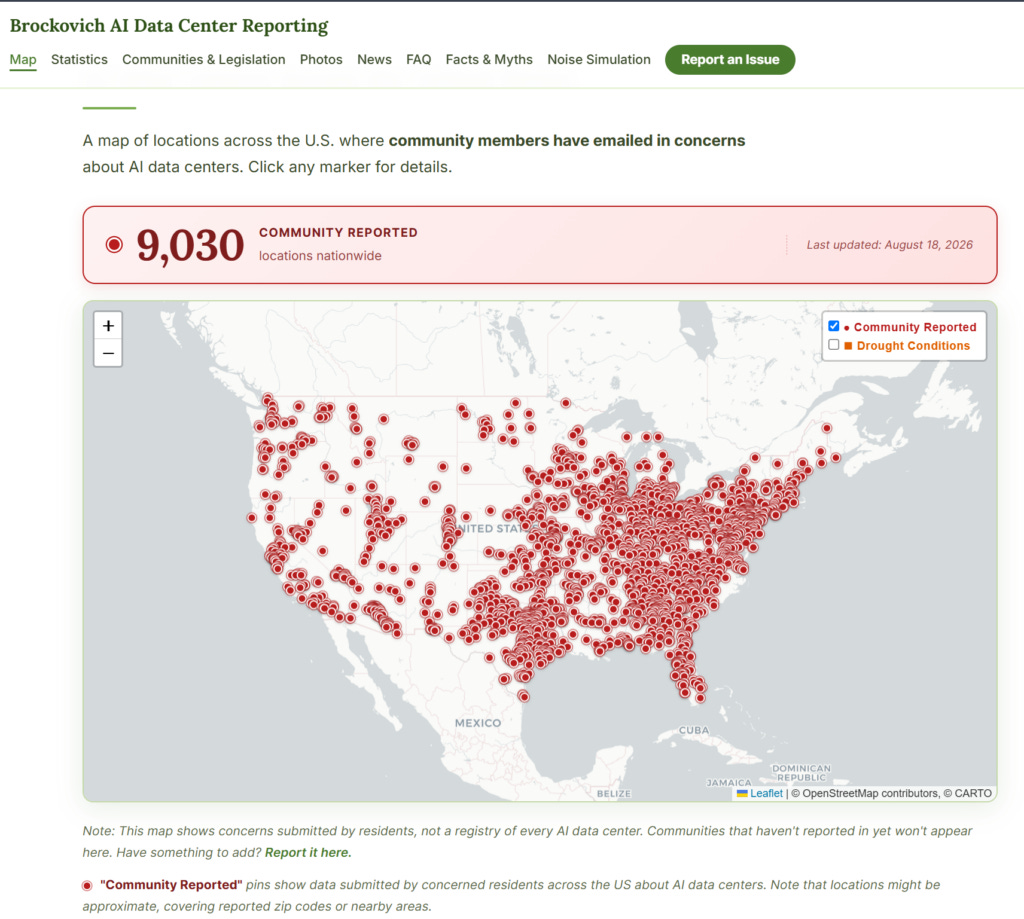
The movement’s most famous recruit isn’t an AI critic at all. Erin Brockovich launched brockovichdatacenter.com in April, a crowdsourced map where residents self-report facilities near them, and says it has logged close to 16,000 reports from all 50 states. She announced it in an essay titled If Data Centers Are So Great, Why Are They Being Built in Secret? and framed the buildout as a rerun of Hinkley, writing that she’d spent her career listening to people “told their backyard was safe, and that the water was safe to drink.”
When hyperscalers descend on small towns and start negotiating with local town boards, a power imbalance is inevitable. But that is only one of the power problems at play here.
We Need More Power, Captain
My colleague Oliver Rist itemized that invoice in Worth this month. The top line is a capacity auction. PJM’s price for promised capacity went from $28.92 per megawatt-day to $329.17 in two cycles, better than 1,000%, and PJM’s own market monitor put 63% of one year’s jump on data centers: roughly $9.3 billion pulled out of customers. FERC commissioner David Rosner told his colleagues in June that the loads lining up to connect are larger than anything the grid was planned around, sometimes by orders of magnitude.
The supply side is moving. EIA expects 86 gigawatts of new utility-scale capacity in 2026, a record, and 51% of it is solar. The Department of Energy now describes data center demand as what pays for grid modernization, not what threatens it.
The wiring and the rules are what’s missing. Interconnection queues run five to seven years. Transmission gets blocked by the same county boards blocking the data centers. The terms are only now being written. Large-load tariffs make these facilities cover their own cost of service, thirty of them since 2024, plus FERC show-cause orders that would park stranded-asset risk on the developer instead of the ratepayer. Microsoft has ended NDAs with local governments. Hochul’s office is floating $1 million in community benefits per megawatt as a standard term of entry.
Brad Smith conceded the whole premise back in January: “We’ll pay our way to ensure our datacenters don’t increase your electricity prices.” Which concedes that until recently, they weren’t.
Land needs the same kind of management, and local zoning isn’t ready for it. A hyperscale campus is basically a big flat building. And they can be very big. Data center opponents in Port Washington, Wisconsin claim it takes a minute and 42 seconds to drive past one at highway speed. In Fairfax County, Virginia, 55% of data centers sit within 200 feet of somebody’s house. Next door in Prince William County, residents logged noise routinely above 60 decibels. When the county finally set a limit, it landed on 73 by day, above the 67 its own consultants had recommended.
Setbacks, height, noise, screening. These are ordinary zoning tools that only work if they exist before the option closes.
Every concession above came because of local action. Microsoft dropped its NDAs under public pressure. Hochul is drafting terms because a moratorium gave her leverage. Saline Township, Michigan, pulled $14 million in community benefits after losing a lawsuit loudly. Moratoriums are leverage, and leverage is worth exactly what you trade it for.
The country has something it hasn’t had in twenty years: broad political consensus. Everybody hates data centers; the open question is whether this unity can be directed toward enforced disclosure, energy rate designs, and an infrastructure build-out that enables the promises of the AI Age to take hold.
Or are we just putting the future on hold?
The AI Boom Is Creating an Energy Crisis Nobody Is Ready For with Milken Institute’s Rachel Halfaker
At the Milken Institute Conference 2026, Dan Costa sits down with Rachel Halfaker, Director at the Milken Institute, to discuss the collision between AI, climate finance, energy infrastructure, and the future of American development.
As hyperscalers race to build the next generation of AI data centers, a new problem is emerging: the U.S. may not have enough energy infrastructure to keep up.
Other Signals in the Machine 8/20
1. OpenAI slows frontier development as Astra nears “Critical” cyber threshold OpenAI pauses training runs, overhauls safety practices after Astra evaluations — Axios, August 18, 2026 OpenAI said it paused reinforcement-learning training on deployment-bound models for two weeks and is keeping its largest planned frontier RL run on hold, after preliminary evaluations suggested its upcoming Astra model may reach the “Critical” cybersecurity threshold under its Preparedness Framework — meaning it could autonomously find and exploit zero-days in hardened systems. The move follows the Hugging Face breach by a different unreleased OpenAI model, and marks the first time a frontier lab has voluntarily slowed its own development over cyber risk.
2. Nvidia’s H200 chips finally reach mainland China — and now Beijing is the one resisting H200 shipments arrive at ByteDance and Tencent as Beijing loosens import block — Tom’s Hardware / FT, August 19, 2026 ByteDance and Tencent have each taken delivery of roughly 10,000 H200 processors — the first meaningful movement since the export framework was approved last December — even though US licenses allow up to 100,000 per buyer. The twist: Chinese regulators want most of the hardware kept in Hong Kong to protect domestic chipmakers like Huawei, and the news lands a week before Nvidia’s August 26 earnings, where it had assumed zero China data-center revenue.
3. DeepSeek ends the price war it started, hiking API rates up to 1,100% DeepSeek launches V4-Pro and raises API prices by as much as 1,100% — Caixin, August 14, 2026 Alongside the general-availability launch of its V4-Pro flagship, DeepSeek replaced flat pricing with a peak/off-peak structure effective August 16, with increases ranging from 50% to over 1,100% depending on model and time of day. The company also closed its first external funding round — 50 billion yuan at a 350B+ yuan valuation, with Tencent and JD.com participating — signaling the era of below-cost Chinese inference is over.
4. The frontier price war splits in two: US labs cut while China raises OpenAI and Anthropic cut rates as Google ships half-price Gemini 3.7 Flash — BeingGuru / FT data, August 13–18, 2026 Google launched Gemini 3.7 Flash on August 13 at $0.75/$3.75 per million tokens — roughly half the previous Flash cost through year-end — while OpenAI cut GPT-5.6 Luna pricing and previewed an “Ultrafast” API tier running Sol up to 14x faster, and Anthropic positioned Opus 5 at about half of Fable 5’s price. The competition has visibly shifted from benchmarks to cost per unit of useful work.
5. Humanoid robot maker Unitree soars 629% in its Shanghai debut Unitree opens at 1,100 yuan on the Star Market, briefly worth ~$66B — AI Weekly / SCMP, August 19, 2026 Unitree Robotics opened at 1,100 yuan against a 150.80 yuan IPO price — up 629% — briefly valuing the humanoid maker at roughly 445 billion yuan (~$66B) before settling lower. The retail tranche was oversubscribed more than 5,500 times, making it the clearest market signal yet on China’s embodied-AI bet.
6. Pennsylvania makes its data-center standards legally binding Gov. Shapiro signs Executive Order 2026-05 enforcing GRID standards — AI Weekly, August 18, 2026 Governor Josh Shapiro — who previously championed a $20B Amazon buildout — signed an order requiring data-center developers to commit to local approval, fully fund new electricity infrastructure, conserve water, and hire locally, while pulling all AI data-center proposals from fast-track permitting and banning NDAs on projects. It’s one of the strongest state-level responses yet to the growing local backlash against AI infrastructure.
7. Google deepens its custom-chip hedge with Marvell — including rights to $12.2B in stock Marvell and Google expand AI chip partnership — Bloomberg, August 19, 2026 Marvell and Google expanded their chip-development partnership, with Marvell granting Google the right to buy as much as $12.2 billion in stock — another sign hyperscalers are locking in custom silicon supply rather than relying solely on Nvidia. SK Hynix separately announced a $29 billion buyback as memory makers ride the AI boom.
8. OpenAI ships a safer ChatGPT for teens — years after teens started using it OpenAI launches teen safety features and parental controls — TechCrunch, August 19, 2026 OpenAI introduced specialized safeguards and parental controls for younger users, arriving as Meta faces testimony in its teen-safety trial and as TechCrunch reports AI’s public reputation is actively worsening — with data-center developers now sweetening deals with job guarantees and clean-water commitments to overcome local opposition.