
Google’s Antitrust Reckoning That Wasn’t
Google will keep Chrome and Apple will continue to bank $20B a year from its search default deal, but the ruling offers little hope for a change in the search marketplace.

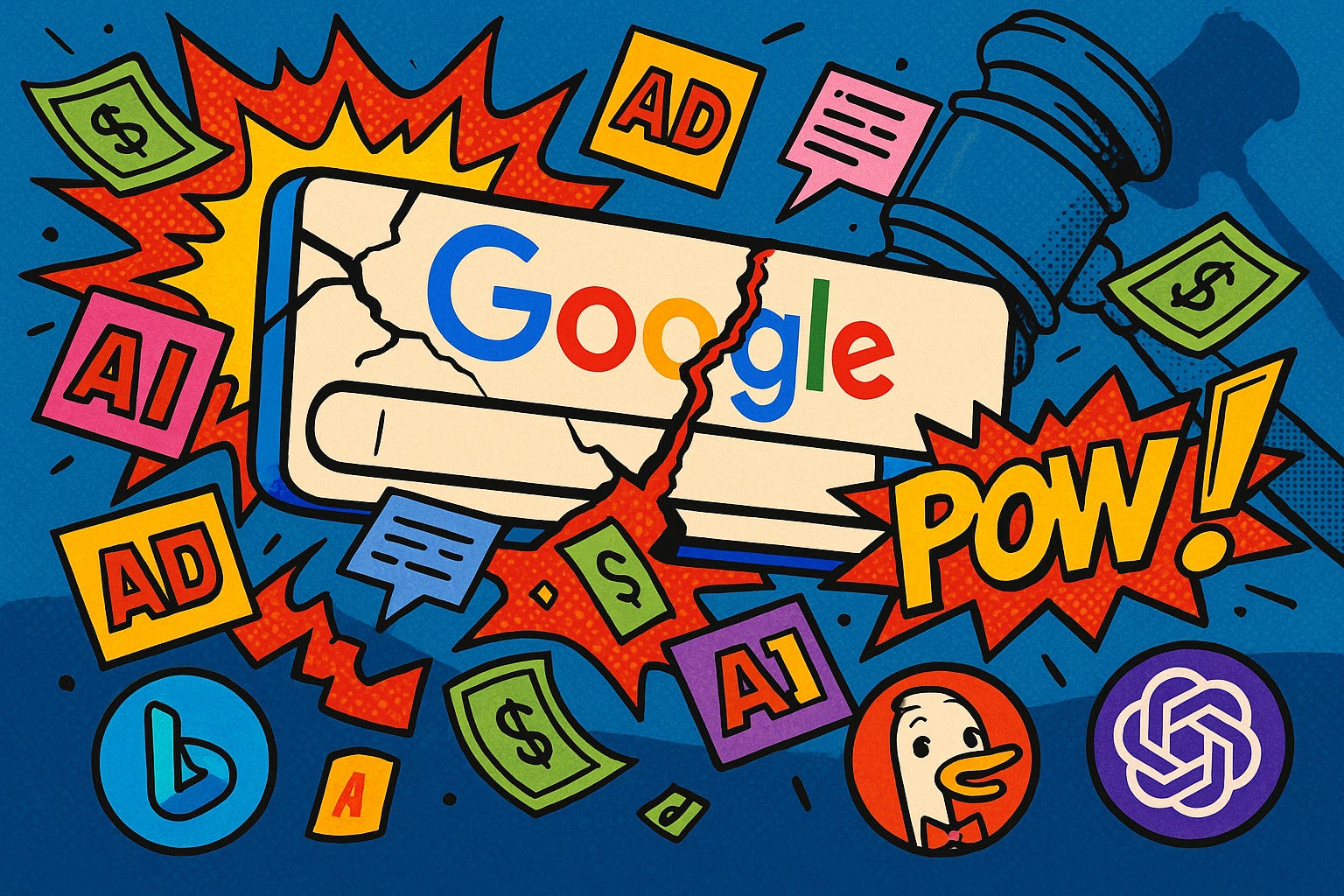
Although I haven’t read every page of Judge Amit Mehta’s 277-page ruling, I feel like I have a pretty good grasp of its consequences. Pretty much nothing. Google will keep Chrome. Apple will keep its billion-dollar search default deal–but now with options! Meanwhile, we’ll keep slogging through search results cluttered with ads, AI-generated overviews, and self-serving affiliate links.
The decision feels less like a reckoning for Google and more like a symbolic scolding—an acknowledgment that the company broke the rules without offering much hope that the marketplace will change.
The market agrees with me. Google's stock is up 9% since the ruling, and Apple received a 3.8% bump on the assumption that it will continue to earn $20 billion a year from bundling Google search.
The Google decision reads like a modern echo of United States v. Microsoft. Judge Amit Mehta found that Google had illegally maintained its search monopoly but opted for behavioral fixes: ending exclusivity, loosening default deals, and—most novel—making Google share parts of its index and query data with rivals. Notably, not the entire algorithm. As former FTC chair William Kovacic put it, Mehta “has chosen remedies that stand a good chance of acceptance by the [Supreme] Court,” a signal that durability, not drama, guided the pen.
Contrast that with Microsoft circa 2001. The D.C. Circuit affirmed the monopolization of Windows but pushed the case toward narrower, process-heavy remedies—an outcome that ultimately left Microsoft intact while the market shifted beneath it. The key analytical difference then and now is switching cost. Antitrust scholar Herbert Hovenkamp captured it years ago: “You do need to show consumer harm … [which] becomes more difficult with search engines, where it is easy for consumers to switch … [unlike] PC operating systems in the Microsoft case, where the technological lock-in was more obvious.”
The historical arc matters. In the desktop era, Microsoft bundled the browser to protect its Windows operating system. In the smartphone era, Google paid to be the default search engine—turning the browser itself into a thin runway that delivers takeoff speed to Google’s ad business. That strategy worked because search “windows” became the new OS start menu for information. Today, that window is cracking: AI agents answer first, link later (if at all).
"Innovation is a hare while antitrust law is a tortoise," Adam Kovacevich, head of the Big Tech-funded industry group Chamber of Progress, recently told Reuters,
The details of the data-sharing mandate will be interesting to see. If enforced effectively, it lowers entry barriers for AI search competitors; if enforced loosely, it becomes a footnote. “The data-sharing requirements pose a competitive risk to Google but not right away… It will take a longer period of time for consumers to also embrace these new experiences,” Cantor Fitzgerald’s Deepak Mathivanan told Reuters. That’s the right read: distribution, habit, and product polish—not just data—decide whether Perplexity, OpenAI, and others can convert access into adoption.
Meanwhile, the consumer experience that justified Google’s dominance has eroded. The open web is drowning in SEO chum; Google’s results are top-heavy with house inventory and ads, and AI summaries increasingly siphon attention before a publisher gets a chance. Ben Thompson is blunt: “search results are polluted by an increasingly overwhelming amount of SEO spam,” now supercharged by generative AI.
Rand Fishkin’s measurement adds a denominator: “for every 1,000 searches on Google in the United States, 360 clicks make it to a non-Google-owned, non-Google-ad-paying property.” In plain English: less oxygen for independent sites, more enclosure inside Google’s garden.
If you’re looking for a bridge back to Microsoft, it’s this: both cases arrive as the platform in question is already being outflanked by the next interface. Netscape lost to the OS; browsers later lost their primacy as the default search engine; now, default search is being challenged by conversational agents and task-oriented UIs.
Tim Wu forecast the enforcement trap back in 2020—“the strongest suit” still yields “remedies… not particularly likely to transform the broader tech ecosystem.” The market keeps skating to the next puck while remedies clean up the last power play.
The bigger problem is that Google Search’s usefulness—buried under sponsored placements, AI overviews, and self-interested affiliate sludge—was already breaking before this ruling landed. Remediating defaults won’t fix that.
And if either side appeals, the clock will run. Google plans to appeal, and the case will likely end up at the Supreme Court—meaning years, well past the point when any remedy can have a meaningful impact on an AI-first market.
Watch: Zoom's AI-Powered Future: Driving Innovation Beyond Video Conferencing
Weekly Readings 9/4/2025
AI Is Coming for Culture
AI isn’t just disrupting industries—it’s redefining what counts as human creativity.Salesforce trims ~4,000 customer-support roles
AI at scale is moving from experiment to headcount, and the human cost is real.SoFi launches an AI ETF
Wall Street’s packaging AI into products faster than the tech itself matures.Mistral nears $14B valuation
Europe’s open-source bet is proving it can compete with the U.S. and China on AI scale.Atlassian to acquire The Browser Company
Is the browser becoming the new battleground for embedding AI directly into work? Who said the browser wars were over?xAI blocks engineer from joining OpenAI
The AI race is now as much about lawyers and IP battles as algorithms.NotebookLM adds tone controls
Personalization is becoming the defining feature of AI-generated content.CoreWeave acquires OpenPipe
Infrastructure players are moving up the stack to own fine-tuning and training.Orchard Robotics raises $22M
AI is quietly transforming food systems with sensors and vision models in the field.“AI Slop” or cultural renaissance?
The future of culture may hinge on whether we value authenticity over abundance.