
Make America Automate Again
Tech giants receive subsidies and preferential treatment. Local communities experience brownouts and budget deficits. Welcome to America’s next industrial chasm.

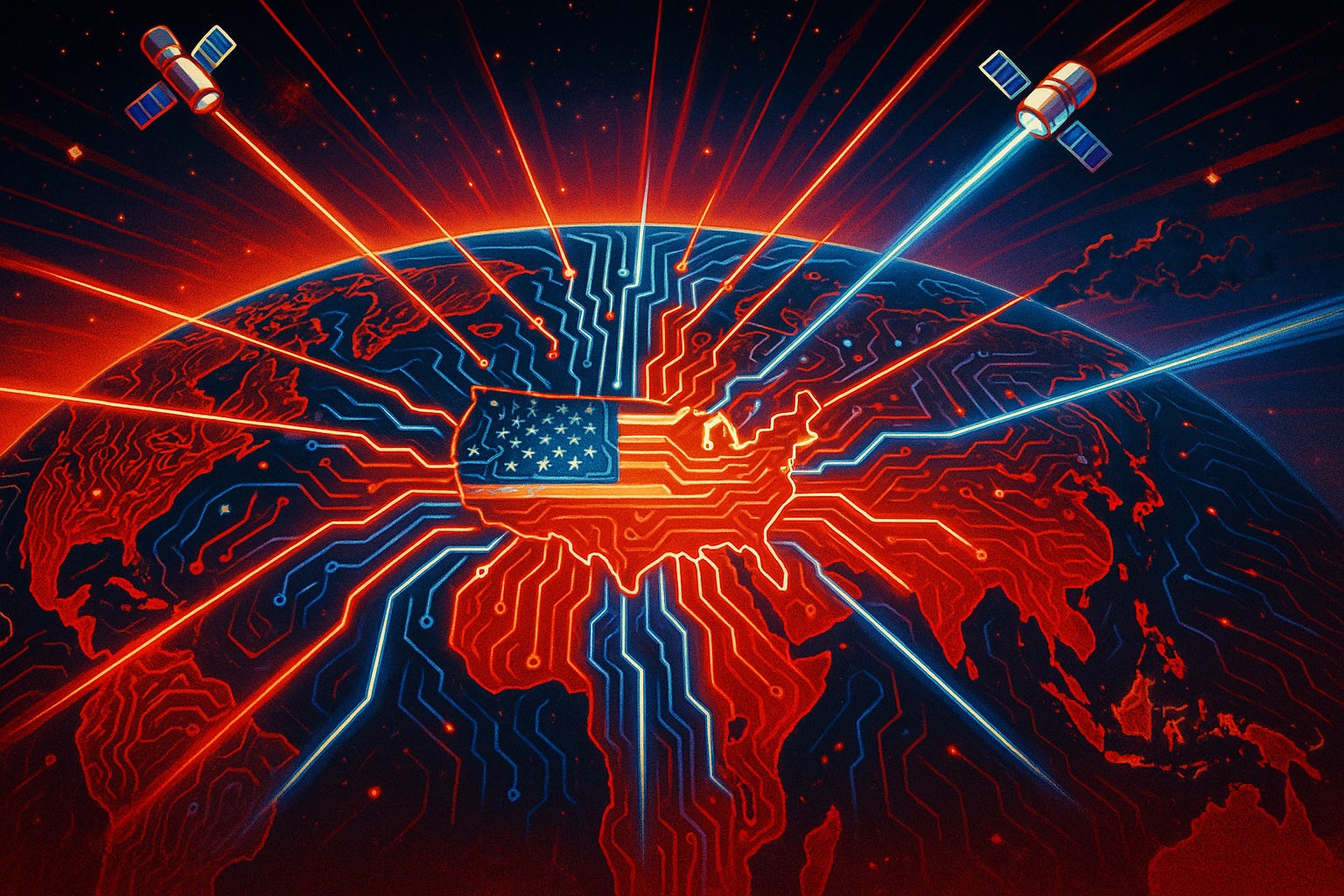
Two weeks ago, the Trump administration dropped its AI blueprint—“Winning the AI Race: America’s AI Action Plan“—alongside a flurry of executive orders aimed at fast-tracking U.S. tech dominance. The document reads like a techno-nationalist fever dream: cut regulations, build faster, crush the competition. Wonder why tech billionaires were writing checks for the inauguration and lining up at Mar-a-Lago? This is why. They didn’t just support the revolution—they bought it. And now, nothing will slow it down.
The plan is ambitious and deliberately polarizing. It tears down guardrails meant to protect workers, the environment, and the public interest, replacing them with incentives for rapid adoption of AI. It also redefines the very role of government in a digital era—from arbiter of fairness to facilitator of private ambition. Discussions of ethical, social, and economic consequences of AI development are over. We are pushing the pedal to the floor.
What’s in the Plan: Key Components
Accelerating Innovation: Rescinds Biden-era safety protocols, expands open-source AI, creates regulatory sandboxes, and launches workforce R&D programs.
Building AI Infrastructure: Fast-tracks data center permitting (100+ MW), circumvents NEPA, and offers financial support for projects exceeding $500M or with national security relevance.
Energy Strategy: Prioritizes dispatchable energy sources—coal, gas, nuclear—while revoking clean energy preferences.
Global Diplomacy & Security: Tightens AI export controls, promotes an “American tech stack” globally, and funds AI-aligned alliances.
Ideological Neutrality: Strips federal AI risk frameworks of DEI, climate, and misinformation considerations, demanding “objective truth” as the standard.
It is, in effect, a blueprint not just for AI dominance, but for a political realignment. The administration has made clear that ethical oversight and environmental concern are secondary to market speed.
And then there is the energy issue. Data centers now consume more than 4% of U.S. electricity. Over half of that comes from fossil fuels, emitting more than 100 million tons of CO2e annually. Training a single large language model can consume over 700,000 liters of water, and AI-driven demand may reach 6.6 billion cubic meters by 2027—half of America’s current water use.
From Memphis, where xAI’s “Colossus” supercomputer stoked local outrage, to Texas, where emergency legislation was passed to allow grid shutdowns of data centers, the strain is clear. In Missouri and Kansas, utilities are already increasing rates to meet the growing energy demands of Big Tech.
Two Americas: One Rises, One Falls
AI is transforming the economy—but only for a few. In Q2 2025, AI-related capital expenditures accounted for a third of all U.S. GDP growth. But the beneficiaries are concentrated within the so-called “Magnificent Seven”: Microsoft, Nvidia, Amazon, Alphabet, Meta, Apple, and Tesla. Together, they account for more than 35% of the S&P 500’s total value.
These companies are projected to spend more than $300 billion on AI infrastructure this year alone. Microsoft and Amazon are each investing upwards of $100 billion. Consumer spending, once the lifeblood of American economic growth, now lags significantly behind AI capital expenditures.
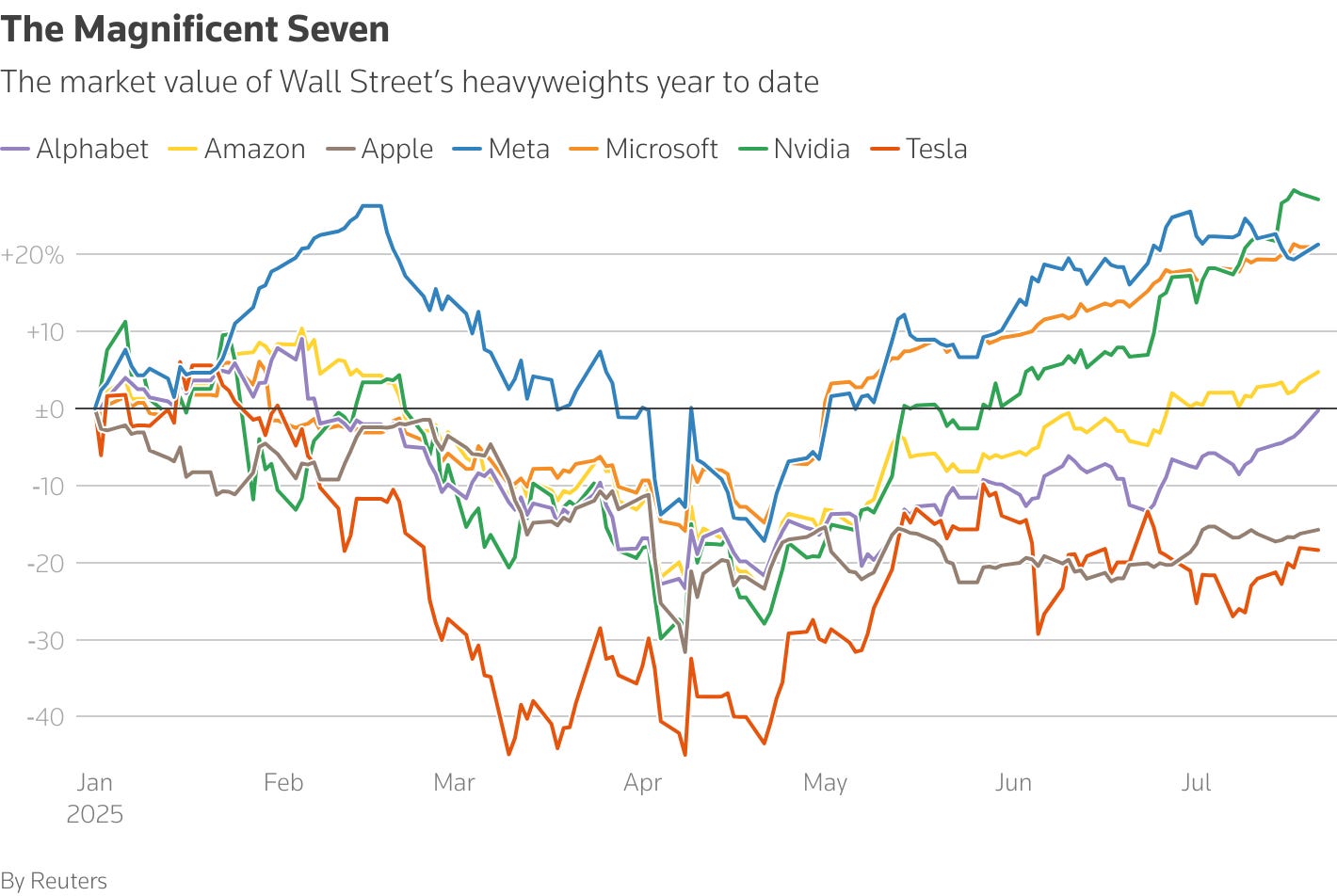
Meanwhile, the rest of the country waits. Small businesses, schools, and local governments see none of the windfall. Many face higher costs—in energy, labor displacement, and digital inequality—without the corresponding benefits. There is no diffusion of innovation. There is only concentration.
This is no accident. The AI Action Plan clears the road for the most prominent players while shrinking the space for challengers. It is both industrial policy and political performance.
Public health advocates estimate the pollution cost of unchecked AI expansion could top $20 billion per year by 2030. Disadvantaged communities—often located near data center hubs—will bear the brunt of this.
In Memphis, Elon Musk’s xAI has rapidly and controversially expanded its “Colossus” supercomputer site—now operating 35 unpermitted gas turbines totaling 422 MW, making it the region’s largest NOₓ emitter. Community groups say xAI bypassed Clean Air Act requirements, triggering legal action and public backlash. The installation—built in record time with little transparency—embodies a broader trend: AI infrastructure scaling unchecked, drawing on fossil fuel-heavy energy sources while exempt from environmental review.
Across the country, the picture repeats. Texas passed emergency legislation allowing utilities to shut off power to data centers during grid strain. In Kansas and Missouri, residents are seeing their utility bills spike as AI-related power demand grows. Meanwhile, in Pennsylvania, utility giant PPL has quietly formed an unregulated joint venture to build power plants exclusively for data centers. xAI’s Memphis gambit may be the most visible, but it’s only the beginning.
And yet, as market returns soar and campaign contributions flow, few in power are asking hard questions. There is no meaningful funding for public AI research. No universal job retraining strategy. No serious climate policy. Just blind acceleration.
The government’s new role in AI isn’t to question, regulate, or balance—it’s to fuel the machine and hope it doesn’t crash.
Meet Me at AI4 Next Week?

Capacity is limited, but you can RSVP here.
What I’m Reading
AI to streamline nuclear licensing
Oak Ridge National Lab is collaborating with startup Atomic Canyon to use AI for fast-tracking nuclear power plant licensing, cutting through piles of regulatory documents at lightning speed.
Apple open to AI M&A as priorities shift
At its Q3 earnings, Apple CEO Tim Cook signaled a renewed focus on AI, revealing openness to acquisitions. The company is restructuring around AI, though Siri's rollout is hitting snags.
Disinformation alert—fake hostage story on Substack
A false Substack post depicting captured British officers in Ukraine used AI-created images and was widely amplified, making waves in misinformation studies.
Meta doubles down on AI talent
Meta reportedly hired top researchers, including Jason Wei and Hyung Won Chung from OpenAI, intensifying the AI brain drain and sparking headlines of paranoia across the Valley.
Last Week in AI newsletter hits high notes
Substack’s Last Week in AI continues delivering smart audio-text summaries of the week’s AI happenings—and it's racking up 98K+ subscribers. An essential pulse-check.
Move 37 examines AI’s creative impact
Josh Bernoff’s Move 37 newsletter explored how AI is warping writers' brains, reshaping the truth, and altering storytellers' workflows. Sharp cultural commentary with a twist.
Mark McNeilly charts AI news highlights
In his Mimir’s Well Substack, McNeilly noted Salesforce claims that AI handles 30–50% of work at his company—spotlighting how quickly enterprise workflows are shifting.